Published by:
CGP EDU Academic Team
Published on: August 13, 2026
If equations (a + 2)x 2 + bx + c = 0 and 2x 2 + 3x + 4 = 0 have a common root where a, b, c ∈ N then-
Text Solution
Verified by ExpertsThe correct answer is:
CHECK THE SOLUTION.
(b, c)
(a + 2)x 2 + bx + c = 0 ....(i)
2x 2 + 3x + 4 = 0 ....(ii)
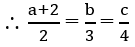
for (ii) D < 0 ⇒ (i) and (ii) have both roots common.
∴ 
∴ for equation (i) D < 0
⇒ b 2 – 4c(a + 2) < 0 ⇒ b 2 < 4ac + 8c
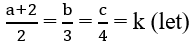
⇒ k ∈ N, k ≥ 2
 = k ⇒ a + b + c = 9k– 2
(a + b + c) min = 16
Prepare Smarter with CGP Edu
Get practice questions, solutions, and test series in one place.
Write a Review
Share your experience with this question and solution.
Commentary
Send your comment, doubt, correction, or feedback to admin.
Similar Questions
Explore conceptually related problems
If 3 is a root of , it is also a root of
If the difference between the corresponding roots of and is same and , then
If the quadratic equations ax 2 + 2cx + b = 0 and ax 2 + 2bx + c = 0 (b c) have a common root, the…
If α α , β β are roots of the equation where then
If a non-zero root of the equation x 2 + 2x + 3 λ = 0 and 2x 2 + 3x + 5 λ = 0 is common, then the v…
If then the value of the expression is equal to -